
Why the strongest senior living leadership searches bring three partners to the table
When a critical leadership position opens, most senior living organizations follow a familiar process. The hiring team defines the role, internal talent acquisition begins recruiting, and candidates are evaluated as they enter the process. It is a reasonable approach. But is it a
complete one? When hiring a CEO, COO, CFO, Executive Director, or another key leader, the question is not simply whether qualified applicants exist. It is whether the organization has explored the strongest leadership talent available.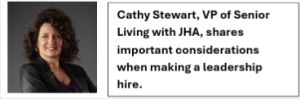
The Three Legs of a Successful Leadership Search
Think of an effective leadership search as a three-legged stool. Its purpose is to identify, attract, evaluate, and ultimately hire the best leader for the organization.
THE FIRST LEG: Organizational leadership and the hiring process. Hiring managers and decision-makers define what success looks like, align on essential competencies, conduct meaningful interviews, and make informed, timely decisions. Even an exceptional candidate can be lost to unclear expectations or a drawn-out process.
THE SECOND LEG: Internal talent acquisition. The internal team advertises opportunities, engages applicants, conducts outreach, coordinates hiring activity, and supports recruitment needs across the organization. This is essential work, often spanning many roles at once.
THE THIRD LEG: An experienced, industry-specific search partner. A specialized recruiter contributes dedicated research, established relationships, market intelligence, and access to accomplished leaders who may not be looking. The recruiter also helps the decision-makers sharpen the profile, structure interviews, assess alignment, and keep the process moving.
The legs are not separate silos. Each strengthens the others. An external recruiter complements internal talent acquisition and collaborates with the hiring team—not simply by providing resumes for passive talent, but by helping the organization make a better decision.
The Best Candidates Aren’t Necessarily Looking
Many accomplished senior living leaders are busy improving occupancy, strengthening financial performance, developing teams, and serving residents. They may be successful and engaged where they are—not reviewing job boards or applying to postings. That does not mean they would never consider the right opportunity. It means someone must earn their attention, establish credibility, and understand what would make a career move worthwhile. Excellent leaders can be active job seekers, too; passive candidates are not automatically better. The point is that an applicant pool alone does not reveal the full field.
Great Recruiters Don’t Just Find Candidates. They Create Candidacy.
Conventional outreach often starts with a job: “We have an opportunity you might like.”Effective executive recruiting starts with the person. What motivates this leader? What have they achieved? What do they want to accomplish next? What conditions would make a change compelling? That conversation can uncover genuine alignment with an opportunity the individual had not been seeking. Creating candidacy takes credibility, curiosity, industry fluency, and trust—not simply access to a database.
Speed With Precision: A Stronger Slate, Sooner
Internal talent acquisition professionals may be balancing frontline vacancies, department-level searches, and daily hiring demands. A specialized search team can dedicate focused research and recruiter attention to a critical leadership role. Researchers identify relevant
leaders; recruiters engage and qualify them. That coordinated effort can shorten the time needed to assemble a thoughtful slate of qualified, interested candidates. Speed does not mean forwarding the most resumes. It means presenting a strong, carefully vetted slate
efficiently. Speed to slate is not identical to speed to hire: decision-makers still need a disciplined, responsive interview and offer process.
A Great Recruiter Strengthens the Hiring Process, Too
Finding the right leaders is only part of the assignment. The organization also needs a process that can recognize, evaluate, and secure them. An experienced search partner can challenge an overly narrow job specification, help distinguish must-have skills from preferences, suggest structured interview questions, surface concerns early, gather useful feedback, and advise on candidate expectations and timing.
That is where the first and third legs reinforce one another. The hiring team owns the decision; the recruiter helps improve the information, process, and momentum behind it. A great recruiter doesn’t just help you find the right leader. They help you make the right hiring decision.
Your Recruiter Is Your Ambassador in the Marketplace
Every conversation with a prospective leader shapes your organization’s reputation in the market. Sometimes accomplished leaders will tell a trusted outside recruiter what they would never say to the organization directly: concerns about turnover, leadership support, culture, or what they have heard from colleagues. Without that conversation, a great candidate may never even consider the opportunity.
That is why a recruiter needs the full story—not simply a job description. Why is the position open? What challenges will the next leader inherit? What has changed? With honest context, an experienced recruiter can address concerns rather than leave rumors unanswered, represent the organization’s mission credibly, and create interest where there may have been none.
Industry Insight Broadens the Possibilities
A senior living specialist understands differences among Life Plan Communities, nonprofit and for-profit providers, faith-based organizations, and multisite operators. They can offer perspective on compensation, competition, leadership motivations, and transferable
experience.
That independent perspective may reveal a leader who does not match every line of the original description but is exceptionally well suited to the organization’s actual needs.
The Cost of Waiting—and the Cost of Not Knowing
Some organizations understandably try to fill a leadership position internally first to avoid a recruiting fee. But waiting 60 or 90 days before broadening the search may mean lost momentum, greater strain on existing leaders, and fewer opportunities to engage exceptional passive talent. For some director-level searches, a contingent partnership can supplement internal efforts without an upfront fee, depending on the agreement; a placement fee generally applies if the organization hires a candidate under that agreement. For highly senior or complex searches, a retained engagement may support dedicated, comprehensive market coverage.
The engagement model is a choice. The value proposition is broader: making a consequential leadership decision with a fuller understanding of the market. Internal and external efforts can run in parallel rather than sequentially.
Leadership Hiring Is an Act of Stewardship
Senior living leaders influence resident well-being, employee livelihoods, organizational culture, and financial sustainability. Selecting the right leader is not simply filling a vacancy; it is advancing and protecting the mission.
The hiring team, internal talent acquisition, and an experienced external search partner each contribute something essential. Working together, they can expand access, create candidacy,
accelerate a quality slate, and strengthen the final decision.
Before your next critical leadership search, ask: Can our organization afford to make this decision without knowing who else might be available? The goal should not be to hire the best person who applies. It should be to hire the best leader for your organization—whether that individual was looking for a new opportunity or not.